
Mixing paradigms
(Highly subjective) AI4Science highlights of April 2026

Repurposing autoregressive models for discrete diffusion
REPR-Align is a new approach for accelerating the training of diffusion generative models for discrete data. Discrete diffusion models for scientific data, such as EvoDiff, have drawn considerable research interest in recent years. However, in practice, they are slower to train and harder to scale than autoregressive models due to the inherent computational efficiency of using causal attention masks with modern deep learning libraries.
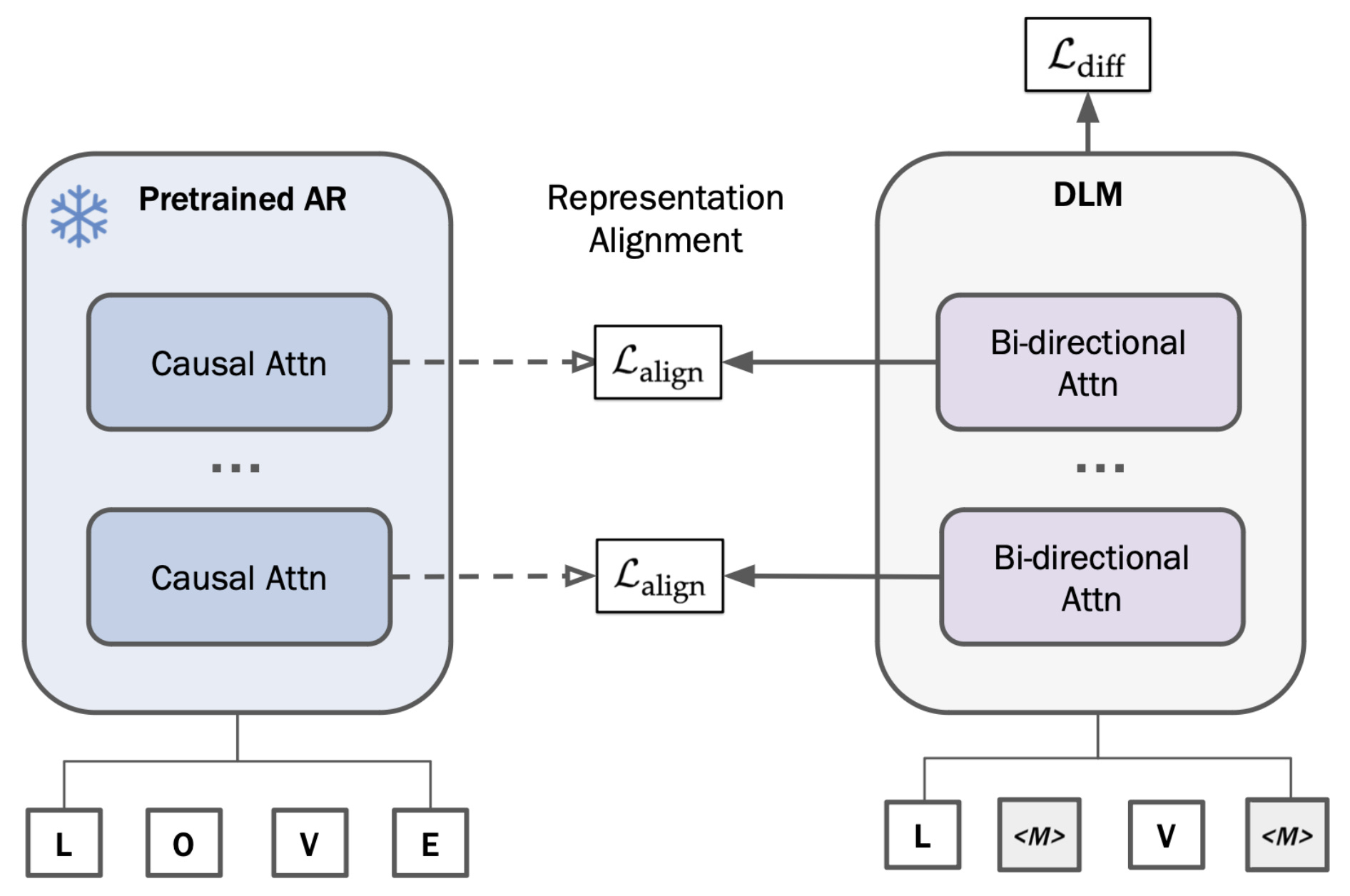
That’s where REPR-Align comes in. The key idea of this method is to align the embeddings of a diffusion/masked language model to those of a pretrained autoregressive model (of which there are many publicly available options). The authors of REPR-Align show that doing so greatly improves the training convergence speed and data efficiency of diffusion language models, offering a path forward to improving such bi-directional models without requiring significant architectural modifications. If you’d like to learn more about this method, its source code is openly available.
Faster sampling of discrete data
In addition to speeding up the training of discrete generative models, how can one accelerate their inference speeds? To answer this question, the authors of REPR-Align concurrently propose Coupling Models. This method relies on the expressiveness of Normalizing Flows to learn embeddings of discrete data that can be tractably mapped to and sampled from a continuous Gaussian distribution. Once such a flow has been trained (in Stage A), a separate one-step (or multi-step) generator network is then trained to invert the flow’s learned mapping between a Gaussian distribution and an empirical (discrete data) distribution.
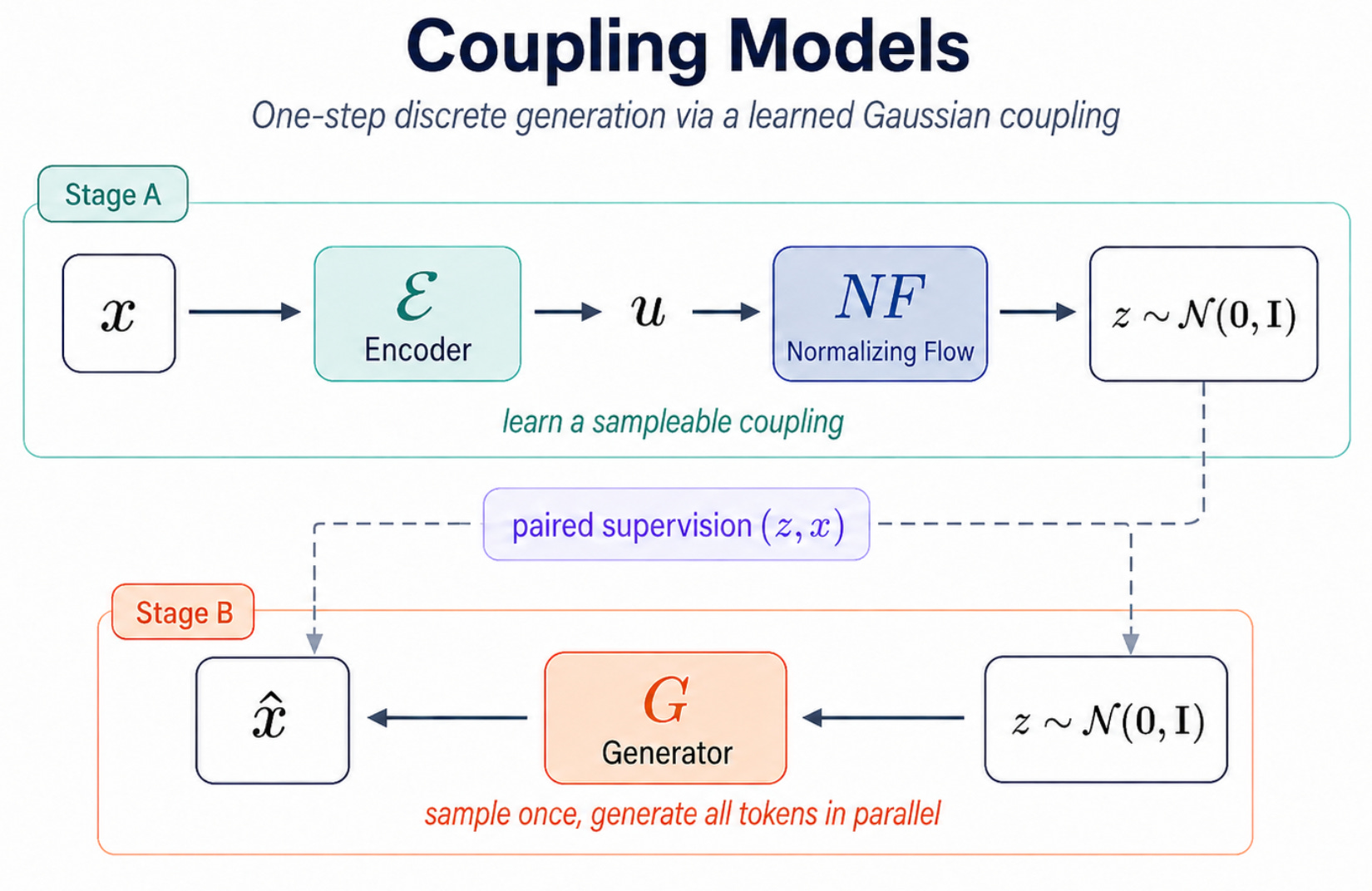
Interestingly, this method not only performs well for standard language datasets, but it also demonstrates notable performance improvements for DNA sequence design (which is a hallmark challenge for discrete generative models in scientific domains). For those curious to learn more and perhaps try this technique out, its source code is freely available.
Reflections
How will advancements in discrete generative modeling impact scientific applications broadly speaking? Will we see any major advancements in fundamental scientific challenges with discrete diffusion/flow matching, or will autoregressive models ultimately prevail in this research area?